Things to Do in Nuremberg: What Is Actually Worth Your Time
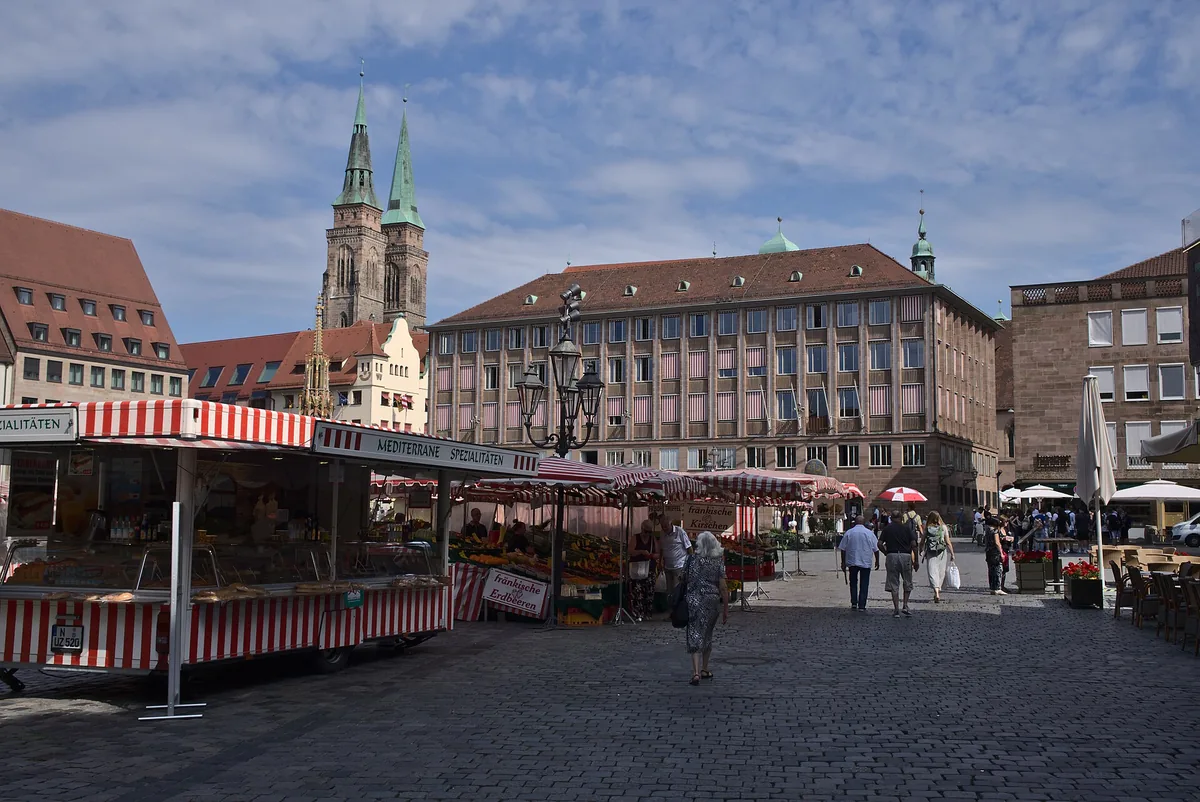
Start with the shape of the place
Almost everything people picture when they picture Nuremberg sits inside the old town, and the old town is small: the castle to the Hauptmarkt is about six hundred metres downhill, and the Hauptmarkt to the main station is a little over a kilometre. You will not need a tram to see the centre. You will need one to reach the rally grounds, which are four kilometres south-east, and the Palace of Justice, which is two kilometres west — and those two are six kilometres apart from each other, which is the single fact that wrecks more Nuremberg itineraries than anything else.
Get that geography straight before you book anything and the rest of the planning does itself. Ignore it and you will spend a day of a two-day trip on trams.
The eight things worth doing
Ranked by what people are actually glad they did, not by search volume. Everything on this list is either free or costs less than a restaurant main.
1. The Kaiserburg — and its courtyard, which is free
The castle is the picture on the postcards and the single most-searched thing in the city. Here is the part nobody tells you: the courtyard, the ramparts and the gardens are open to anyone, cost nothing, and carry the view. The paid ticket gets you inside the Palas, the double chapel, the museum and the Deep Well — worth it, but a separate decision from "seeing the castle". Full castle guide, with what each ticket covers.
2. The Hauptmarkt, the Frauenkirche and the Schoener Brunnen
The main square, free, and the centre of gravity of the whole old town. The Frauenkirche mechanical clock runs at noon. The fountain has a brass ring set into its railing that everyone turns for luck; the wrought-iron work around it is the genuinely remarkable part and almost nobody looks at it. The old town, street by street.
3. The former Nazi Party Rally Grounds
Open parkland, unfenced, free, and larger than people expect — the Zeppelin grandstand, the unfinished Congress Hall, the parade road. It is not a museum and there is very little on-site interpretation, which is exactly why it either lands hard or means nothing at all, depending on what you bring to it. What is there, and how to reach it.
4. The Documentation Centre
The museum that explains the ground above. Its new permanent exhibition opened in 2026, which means most guidebooks describe a show that no longer exists. EUR 7.50, about ninety minutes, tram 8 to the door. What has changed, and what to expect.
5. Courtroom 600
The actual room where the Nuremberg Trials were held, two kilometres west of the old town at the Palace of Justice, open as a museum. Nearly every other guide still warns you it closes when the court is in session. It stopped being a working courtroom in March 2020. The current opening rules, and the 2026 closure dates.
6. Underground — the rock-cut cellars and the bunkers
The one category here you cannot do alone, because every entrance is locked. Four separate underground systems run beneath the city: the medieval beer cellars, the art bunker that hid the imperial regalia, the nuclear bunker under the main station, and the dungeons under the old town hall. All four, compared.
7. Three bratwurst in a roll, standing up
Drei im Weggla, from a hatch, eaten in the street, for the price of a coffee. It is the cheapest genuinely local thing you can do here and it takes four minutes. Where to get it and what makes it protected.
8. The Christkindlesmarkt, if you are here in December
Free to walk into, about two hundred stalls, and by a distance the busiest thing that happens in this city all year. If you are coming in December this is not one item on a list, it is the reason the trip costs what it costs. Dates, hours and how to do it without the crush.
What you can skip
Said plainly, because a guide that recommends everything recommends nothing.
What works
- The castle courtyard, even if you skip the paid interior
- The Weissgerbergasse, the one street that survived the war intact
- The Handwerkerhof if you have twenty minutes and are near the station
- The Germanisches Nationalmuseum if you like museums at all — it is the largest collection of German cultural history anywhere
Worth knowing
- The Schoener Brunnen ring, as an activity rather than a thirty-second stop
- The tourist land-train, unless you are travelling with small children
- The zoo, unless you have a full spare day — it is five kilometres out
- Any "Nuremberg trials" attraction that is not the Memorium itself
If you would rather be shown round
You do not need a guide for the old town. It is small, well signposted, and walking it alone works. What a guide adds here is specific: the buildings you are looking at are mostly post-war reconstructions of medieval originals, and without someone to tell you which is which, you will not see it. That is a real gap and a two-hour walk closes it cheaply.
Can’t make these dates?
Browse more tours and activities in Nuremberg and find one that fits your schedule — all with instant confirmation and free cancellation.
Fitting it into the time you have
| Time you have | What fits | What to cut |
|---|---|---|
| Half a day | Castle courtyard, Hauptmarkt, bratwurst | Everything south-east of the station |
| One day | Old town in the morning, one Nazi-era site after lunch | The second Nazi-era site — they are 6 km apart |
| Two days | Old town + castle, then rally grounds + Doku + Courtroom 600 | Museums, unless it rains |
| Three days | All of the above, plus underground and a day trip | Nothing — three days is comfortable |
Detailed hour-by-hour versions: one day and two days. If you are weighing the city against its bigger neighbour first, Nuremberg or Munich is the honest comparison.
Frequently asked questions
How many days do you need in Nuremberg?
Two nights is the honest minimum if you want both halves of the city — the medieval old town and the Nazi-era sites. One full day does one of them properly. People who give it a single afternoon almost always see the old town and leave thinking Nuremberg is a pretty small town, which is only half true.
Is Nuremberg walkable?
The old town, completely — it is about 25 minutes end to end and everything inside it is a short walk from everything else. The Nazi-era sites are not. The rally grounds are 4 km south-east and the Palace of Justice 2 km west, on different tram and U-Bahn lines, so budget a transport ticket for those.
What is Nuremberg best known for?
Three things, in roughly this order for most visitors: the Christkindlesmarkt, the Nuremberg Trials, and the medieval imperial city with its castle. It is also the home of a protected bratwurst and a protected gingerbread. The full answer is here.
Can you see the rally grounds and Courtroom 600 in one day?
Yes, but plan it. They are six kilometres apart on opposite sides of the city and the Memorium closes on Tuesdays. Do Courtroom 600 first thing, cross the city at midday, and give the afternoon to the Documentation Centre and the grounds.
Is anything in Nuremberg free?
More than you would guess. The castle courtyard, ramparts and gardens, the entire rally grounds site, the Hauptmarkt and every church, the city walls, and entry to the Christmas market itself. The paid list is short: the castle interior, the museums, and the underground tours.