Why Is Nuremberg Famous? Five Answers, and They Are All Different
1. The imperial city
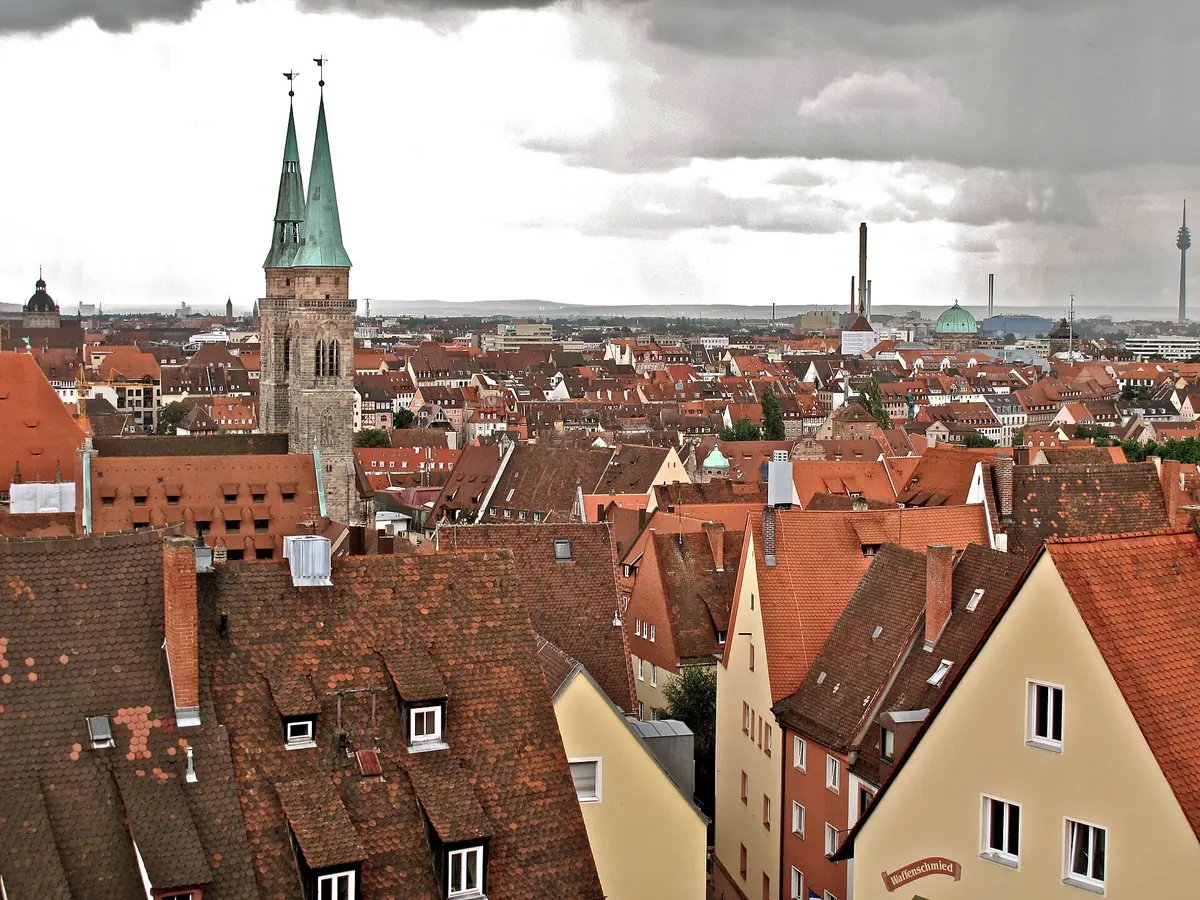
From 1356, the Golden Bull required every newly elected Holy Roman Emperor to hold his first Imperial Diet at Nuremberg. The imperial regalia — crown, orb, sceptre — were kept here for nearly four hundred years. That is why there is a castle on the rock, and it is why the Nazis later wanted the city: they were not choosing a random Bavarian town, they were annexing its symbolism.
2. The printing, painting and instrument-making capital
The chapter people forget. Albrecht Duerer worked here. Anton Koberger printed the Nuremberg Chronicle here in 1493, one of the most ambitious books of the century. The pocket watch and the clarinet were both developed here. For roughly a century Nuremberg was the most technically advanced city north of the Alps, and the Germanisches Nationalmuseum is where the evidence lives.
3. The Nazi Party rallies
Between 1933 and 1938 the party held its annual rallies on purpose-built ground south-east of the city, on a scale designed to be filmed. The laws stripping German Jews of citizenship were announced at the 1935 rally, which is why they are called the Nuremberg Laws — the name is an accident of venue, and it stuck. The site is still there, and free to walk.
4. The Nuremberg Trials
The Allies chose the city partly for the symbolism and partly for the practical reason that the Palace of Justice had survived the bombing largely intact and had a prison attached. Twenty-one defendants were tried in Courtroom 600 between November 1945 and October 1946. The room is open to visitors today. What you can actually see, and when.
5. The Christkindlesmarkt
Documented since the early seventeenth century and the template most other German markets copy: wooden stalls with red-and-white cloth, a strictly policed ban on plastic tat, and an opening address by a Christkind chosen from the city's teenagers every two years. Free to enter. Dates and hours.
And two things it is famous for eating
Both are protected under EU law, which is a stranger fact than it sounds: it is illegal to sell a sausage as a Nuernberger Rostbratwurst unless it was made inside the city limits to a specification that fixes its length at 7 to 9 centimetres. The same applies to Nuernberger Lebkuchen.
How the reputations sit together
Uncomfortably, and the city does not pretend otherwise. The rally grounds were chosen because of the imperial history; the trials were sited here because of the rallies; the Christmas market was revived in 1948 in a city that had just been flattened. Nuremberg is unusual among German cities in having decided, fairly early, to keep all of it visible rather than tidy the difficult parts away. Whether that makes it worth a trip is a separate question, answered separately.
Frequently asked questions
What is Nuremberg most famous for?
Internationally, the Nuremberg Trials of 1945-46. Within Germany, the Christkindlesmarkt. Among historians, its four centuries as the effective capital of the Holy Roman Empire. All three are true at once, which is what makes the question hard to answer in one line.
Why were the Nuremberg Trials held in Nuremberg?
Two reasons. The symbolic one: the city had been the Nazis' ceremonial stage and the venue of the 1935 race laws. The practical one: the Palace of Justice had survived the bombing more or less intact, was big enough, and had a prison attached to it — which mattered a great deal in 1945.
Why did the Nazis choose Nuremberg for their rallies?
Because of what the city already meant. It had been the site of the imperial Diets and the home of the imperial regalia, so holding the party rallies there let the regime borrow a thousand years of legitimacy it did not have. The good rail connections and the sympathetic local party helped.
Are the Nuremberg Laws named after the city?
Yes, and only because of where they were announced — at the 1935 party rally in Nuremberg. The city had no part in drafting them. The name is an accident of venue that has attached itself to the place permanently.
What food is Nuremberg famous for?
Nuernberger Rostbratwurst, a finger-sized marjoram sausage eaten three to a roll, and Nuernberger Lebkuchen, a nut-heavy gingerbread baked on a wafer. Both carry EU protected geographical status, so both must be made inside the city.